Physical AI for
Smart Quality Inspection That Learns from Your Line

Own Product
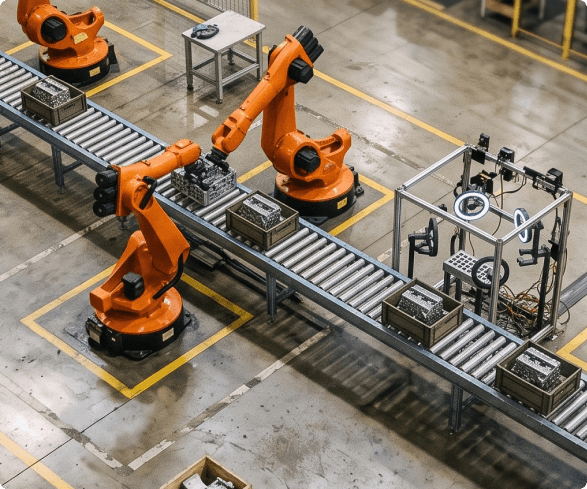
NEXUS is ASSIST Software's industrial inspection orchestration platform. It uses digital twins to plan inspections, coordinates robotic scanning, and applies computer vision to deliver traceable PASS/FAIL results. Designed to integrate with existing hardware and software, NEXUS also collects inspector-reviewed findings to support continuous model improvement.
Industry
Services
Country

Company size
A Unified Workflow for Automated Inspection
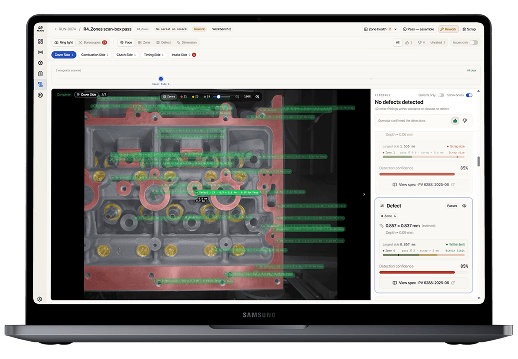
NEXUS brings inspection planning, robotic execution, computer vision, and reporting into one workflow. Engineers can register parts, generate inspection plans, validate them in a digital twin, and execute them on a robotic cell.
The platform delivers traceable PASS/FAIL results, while flagged findings are reviewed by inspectors. Their feedback is collected to help improve computer vision models through VisionForge.
Features we developed
The Technology Behind NEXUS
A modular edge-native architecture combining robotics, digital twins, computer vision, retrieval-based knowledge, and orchestration in one industrial inspection platform.







Designed as a Modular Inspection Platform
NEXUS separates orchestration, document intelligence, defect detection, and robotic control into independent services. Its modular architecture allows components, models, and hardware integrations to evolve without rebuilding the entire system. Designed for scalability, NEXUS enables new inspection stations and part variants to be configured through digital twins, reusing the same platform rather than starting from scratch.
One Ecosystem for Industrial Inspection
NEXUS is part of ASSIST Software's industrial inspection ecosystem, connecting inspection execution, AI model training, and production-level insights. Each component has a distinct and complementary role, with the architecture designed to support continuous improvement across inspection stations.
Trains computer vision models using synthetic, real, and augmented images. Inspector-reviewed findings from NEXUS can support further model improvement.
From design to completion, we ensure outstanding products

VisionForge


Mesalvo
Discuss Your Quality Inspection Requirements
For business inquiries:
hello@assist.ro
Our address:
1 Tipografiei Street 720043, Suceava, Romania
Frequently Asked Questions
1. Can you integrate AI into an existing software product?
Absolutely. Our team can assess your current system and recommend how artificial intelligence features, such as automation, recommendation engines, or predictive analytics, can be integrated effectively. Whether it's enhancing user experience or streamlining operations, we ensure AI is added where it delivers real value without disrupting your core functionality.
2. What types of AI projects has ASSIST Software delivered?
We’ve developed AI solutions across industries, from natural language processing in customer support platforms to computer vision in manufacturing and agriculture. Our expertise spans recommendation systems, intelligent automation, predictive analytics, and custom machine learning models tailored to specific business needs.
3. What is ASSIST Software's development process?
The Software Development Life Cycle (SDLC) we employ defines the stages for a software project. Our SDLC phases include planning, requirement gathering, product design, development, testing, deployment, and maintenance.
4. What software development methodology does ASSIST Software use?
ASSIST Software primarily leverages Agile principles for flexibility and adaptability. This means we break down projects into smaller, manageable sprints, allowing continuous feedback and iteration throughout the development cycle. We also incorporate elements from other methodologies to increase efficiency as needed. For example, we use Scrum for project roles and collaboration, and Kanban boards to see workflow and manage tasks. As per the Waterfall approach, we emphasize precise planning and documentation during the initial stages.
5. I'm considering a custom application. Should I focus on a desktop, mobile or web app?
We can offer software consultancy services to determine the type of software you need based on your specific requirements. Please explore what type of app development would suit your custom build product.
- A web application runs on a web browser and is accessible from any device with an internet connection. (e.g., online store, social media platform)
- Mobile app developers design applications mainly for smartphones and tablets, such as games and productivity tools. However, they can be extended to other devices, such as smartwatches.
- Desktop applications are installed directly on a computer (e.g., photo editing software, word processors).
- Enterprise software manages complex business functions within an organization (e.g., Customer Relationship Management (CRM), Enterprise Resource Planning (ERP)).
6. My software product is complex. Are you familiar with the Scaled Agile methodology?
We have been in the software engineering industry for 30 years. During this time, we have worked on bespoke software that needed creative thinking, innovation, and customized solutions.
Scaled Agile refers to frameworks and practices that help large organizations adopt Agile methodologies. Traditional Agile is designed for small, self-organizing teams. Scaled Agile addresses the challenges of implementing Agile across multiple teams working on complex projects.
SAFe provides a structured approach for aligning teams, coordinating work, and delivering value at scale. It focuses on collaboration, communication, and continuous delivery for optimal custom software development services.
7. How do I choose the best collaboration model with ASSIST Software?
We offer flexible models. Think about your project and see which model would be right for you.
- Dedicated Team: Ideal for complex, long-term projects requiring high continuity and collaboration.
- Team Augmentation: Perfect for short-term projects or existing teams needing additional expertise.
- Project-Based Model: Best for well-defined projects with clear deliverables and a fixed budget.
Contact us to discuss the advantages and disadvantages of each model.